Tuesday, November 24, 2009

Hometown Heroes


“Throughout the year we produce 12 different menus every day, so we meet the specific nutritional needs of the clients," stated Craig Shinderman, The Director of Food & Friends' in Washington, D.C. "But Thanksgiving is an All-American Holiday and people really like turkey, stuffing, greens, mashed potatoes, cranberry sauce, rolls, pumpkin pies. We provide the whole nine yards, thousands and thousands of pounds of food."

In fact--8,400 pounds of turkey, 975 pounds of cornbread stuffing, 1,050 pounds of mashed potatoes and 2,600 dinner rolls.


Mr. Shinderman was standing in the kitchen of Food & Friends' Headquarters off Riggs Road in N.E. Washington. "This a monumental effort and it’s a traditional feast. We know our clients are sick and kind of living at the margins of society. The role of Food & Friends’ is to help those people maintain a dignified and independent life. And on Thanksgiving, we want them to share this All-American Holiday.”


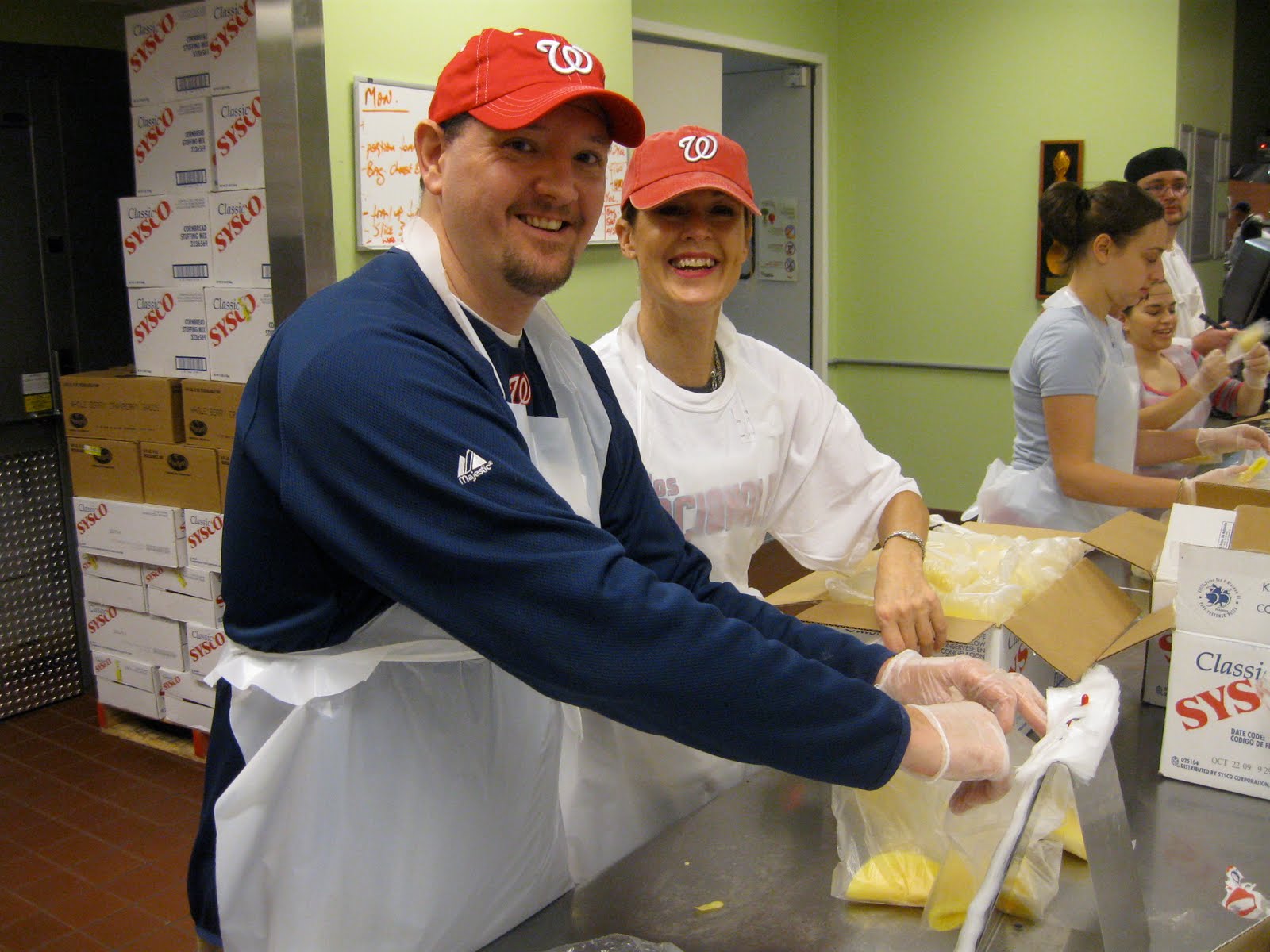
A meal that could not be provided without the thousands of volunteers whom give their free time to help out those in need. These Hometown Heroes as Mr. Shinderman calls them that on Monday, November 23rd, included nearly 30 Front Office Staff of Our Washington Nationals, along with Pitcher Craig Stammen. Two teams that worked two shifts at Food & Friends'. The first of four labor intensive days involved in the cooking, preparing and packaging of nearly 3500 Thanksgiving Dinners that will be delivered this Thursday Morning.


“This is a chance to help some people out here who are less fortunate and are not in position to have that typical Thanksgiving--like so many others are accustomed to," said Craig Stammen. "So, it’s very nice to be here and give them a helping hand—and give them some good food to eat as well. I am accustomed to growing up in a big farm community where everybody pretty much does their own thing. So, living in the city (now), has exposed me to what’s not perfect in the world."

Food & Friends' formed in 1988 to serve those suffering from HIV/Aids, but now has grown to also help those with cancer and life-threatening illnesses.


Craig Shinderman: “All of our clients are critically ill with HIV/Aids and Cancer--and most of our clients are referred to us by health care providers. But our program is not specifically an anti-hunger program, though our clients are in need of food. We are a part of a system of medical care where the nutritional support we provide--is a part of the total program of medical care for the clients.”

1/3rd of Food & Friends' $8 Million Dollar annual budget comes from local, state and federal funding. The remainder from generous contributions from corporations, foundations and The United Way. In September 2008, former Washington Redskins Coach Joe Gibbs came to Food & Friends' with his NASCAR Driver--Denny Hamlin--as part of FedEx Cares Day. "Of course, it didn’t spark my NASCAR career!" laughed Craig Shinderman, "I am still driving my Ford Truck. But they did give us a Toyota Prius for the organization. And Coach Gibbs made a very generous personal contribution that was not originally in the plans. I think he was very touched by the experience."

Joe Gibbs getting that belonging feeling that comes from giving ones self today--so others may lead a better life tomorrow.


Yesterday was the fourth visit by Nationals Staff over the past few years, but this relationship between Food & Friends and Washington's Baseball Team was forged before Baseball Returned to Washington in 2005. "We have a nice connection with the family that owns the team (The Lerner Family)," stated Mr. Shinderman. "Marla Lerner Tanenbaum is a former member of our Board of Directors at Food & Friends’. She and the family have maintained that connection. The family is charitable and very supportive of our work. So, I believe The Nationals visiting here today is an extension of their wonderful philanthropy.”

Marla Lerner Tanenbaum: "We’ve been supporters for many years. The motivation for our gift was my mother (Annette Lerner) recalling how she made chicken soup for a dear friend of hers who was dying of AIDs. This was many years ago and my mother was struck by how nourishing the soup was to his soul and spirit. So, when a good friend asked me to participate (as a board member), the memory of that incident came to mind. It’s a great organization; it does such meaningful and important work and it’s run by smart people who respond to the community’s needs."

Just outside Food & Friends' main door is a garden endowed by The Lerner Family.


As Nationals Staff helped prepare the turkeys, sorted canned and baking goods, poured soup into protective containers and wrapped meals--they were joined on Monday by other volunteers from Capital One's Main Headquarters in Tyson's Corner, Virginia and students from Penn State. In a typical year, nearly 11,000 volunteers will assist the 50 staff members of Food & Friends'. Six days a week, meals are prepared and delivered to their nearly 3000 clients. This week, the nearly 3500 meals to be sent out for the Holiday Feast, will be assisted by over 800 volunteers.


"We simply wouldn't be able to do this without the volunteers," believes Shinderman. "The volunteers are critical. With only 50 on staff, we would never be able to deliver over 1 million meals in 2009. Every day people are the celebrities here every day, and especially on Thanksgiving. The 800 people that are here today, tomorrow, Wednesday and Thursday--we applaud them as they are leaving the building carrying their deliveries. These people always look shocked as every day people are rarely treated as celebrities. But for us—they are our Hometown Heroes."


Final preparations in Food & Friends' Kitchen will begin at 4AM Thanksgiving Morning. Just a few hours later, those many Hometown Heroes will be out on the streets of 14 counties and cities in Maryland, Virginia and District Of Columbia delivering that All-American Family Holiday Meal. Volunteers like members from Our Washington Nationals Family, whom gave a few hours of their time Monday in N.E. Washington so those with HIV/Aids, Cancer and Life Threatening illnesses can spend more time peacefully, and happily, with their families on Thanksgiving Day.

All Photos Copyrighted--Nats320--All Rights Reserved

Monday, November 23, 2009

Rewarded For Making A Difference

Late in October, Our Washington Nationals Ryan Zimmerman was nominated for The All Stars Helping Kids Award as one of 53 athletes across this country helping out in the surrounding community's they live and work. 10 Winners to be placed on The Dream Team Of Public Service.

This afternoon, Ryan Zimmerman was awarded a deserved spot on that Dream Team. The Z-Man to be officially recognized in New York City at the third annual Sports Business and Philanthropy Luncheon on Tuesday, December 8. Then, next June 22nd, he will be on hand at The Jefferson Awards For Public Service--right here in The Nation's Capital--where two Dream Team Members will be honored with the very prestigious Jefferson Award--given to those who have given their heart and passion, selflessly, to others in need.

Ryan Zimmerman Rewarded For Making A Difference.

Here is the complete press release from Our Washington Nationals:

Granderson, Zimmerman Among 'All Stars Helping Kids' Winners For 2010 Jefferson Awards For Public Service

Tigers outfielder and Nationals third baseman Join World Champions Venus Williams and Lauryn Williams, NBA All-Stars Dwight Howard and Dirk Nowitzki, NFL star Justin Tuck on “Dream Team For Public Service”

SAN FRANCISCO (November 23, 2009) – Detroit Tigers outfielder Curtis Granderson and Washington Nationals third baseman Ryan Zimmerman are among 10 “Dream Team for Public Service” winners from among 53 nominees selected for the Jefferson Awards for Public Service, which will recognize the top athletes who have given back to their community. Ronnie Lott, NFL Hall of Famer and founder of All Stars Helping Kids, today announced the winners, who will will be officially recognized in New York City at the third annual Sports Business and Philanthropy Luncheon on Tuesday, December 8.

In addition, two top winners will be honored at the national Jefferson Awards ceremony June 22nd in Washington, D.C. Past Jefferson Awards winners include four Supreme Court Justices, seven Secretaries of State; as well as Oprah Winfrey, Alan Greenspan, Peyton Manning, Colin Powell, Lance Armstrong, Barbara Bush and Bill and Melinda Gates.

The 10 “Dream Team For Public Service” winners (whose capsule accomplishments are attached) were selected by the prestigious Jefferson Award board and public voting:

· Nnamdi Asomugha (Lafayette, La.), defensive back, Oakland Raiders, NFL
· Curtis Granderson (Chicago), all-star outfielder Detroit Tigers, MLB
· Stuart Holden (Houston), forward, Houston Dynamo, MLS
· Dwight Howard (Orlando, Fla.), all-star forward, Orlando Magic, NBA
· Dirk Nowitzki (Wurzburg, Germany), all-star forward, Dallas Mavericks, NBA
· Tyrus Thomas (Baton Rouge, La.), forward, Chicago Bulls, NBA
· Justin Tuck (Coosa County, Ala.) all-pro defensive end, New York Giants, NFL
· Lauryn Williams (Rochester, Pa.), Olympian and World Champion sprinter
· Venus Williams (Palm Beach Gardens, Fla.), Olympian and Grand Slam champion, WTA
· Ryan Zimmerman (Washington, N.C.) all-star third baseman, Washington Nationals, MLB

Teams from across the sports world nominated 53 athletes from 10 sports, with each athlete having a track record of community outreach as well as a sincere passion for service. Fan voting was conducted online or via text message, with over 25,000 votes logged during the process.

“These champions represent a wide swath of success both on and off the playing field, and we are very excited to be able to honor this group,” Lott said. “The real winners in this process are the millions of people that all these athletes have assisted in community service. It is an honor for us to recognize this group and assist all of them in their very noble endeavors.”

Sam Beard, founder of the Jefferson Awards for Public Service said, “Many times we forget that elite athletes from so many different walks of life are using their stature to make an impact – especially as role models for young Americans. This group is a great cross-sampling of what is being done in so many sports to impact the lives of others. They are all leaders and champions in their own way and we are proud to salute them all.”

About All Stars Helping Kids:

Since 1989, All Stars Helping Kids has been a galvanizing force and vehicle for individuals and corporate partners to invest in the future of children in the San Francisco Bay Area and beyond. All Stars Helping Kids’ mission is to promote a safe, healthy, rigorous learning environment for disadvantaged children in low-income communities.

About the Jefferson Awards for Public Service:

The Jefferson Awards for Public Service is a prestigious national recognition system honoring community and public service in America. The Jefferson Awards were established in 1972 by Jacqueline Kennedy Onassis, U.S. Senator Robert Taft, Jr. and Sam Beard to establish a Nobel Prize for public service. Today, their primary purpose is to serve as a "Call to Action for Volunteers" in local communities. The Jefferson Awards Board of Selectors is co-chaired by the majority and minority leaders of the United States Senate – The Honorable Harry Reid and The Honorable Mitch McConnell, as well as Laura Bush, Teresa Heinz, Julian Bond, Michael Douglas, Whoopi Goldberg, and Lesley Stahl. 155 television stations and newspapers serve as Jefferson Awards media partners across the country highlighting grassroots “Unsung Heroes.”

Photo Copyright--Nats320--All Rights Reserved

Sunday, November 22, 2009

The Ballpark District


Since the recession hit The United States a few years ago, both Lehman Brothers and Corus Bank have fallen. It just so happens both were also major investors in The Ballpark District surrounding Nationals Park. The Huffington Post released this past Friday a well produced story describing The Ballpark District's languishing re-development prospects. Specifically, the story looks at The Half Street Project of Monument Realty--their 55 M Street, S.E. building now erected above the West Entrance to the Navy Yard Metro Station and the accompanying open pit that exists on the east of Half Street, S.E. as one exits the Metro Station and walks toward Center Field Gate at the ballpark.

Remember this snazzy video produced by Monument Realty to promote Half Street? (Use this link if the video below is cut off on your screen--blogger seems to have a problem with the placement)


Bottom line?

Don't expect a whole lot more anytime soon, sadly. The economy is still lagging, commercial real estate is taking a big hit, and banks are nowhere close to lending out dollars as they were five years ago. A few more years are going to pass before The Ballpark District success can be reached. It took 10 years for the Chinatown area surrounding Verizon Center (originally called MCI) to totally take shape. Eight more years for South Capitol Street, Half Street, Potomac Avenue, 1st Street, M Street and N Street--all in S.E.--to catch up with Nationals Park--probably not out of the question either.

Saturday, November 21, 2009

Fortunate


The Washington Redskins Jason Campbell, The New York Jets Mark Sanchez (although his injury occurred his senior year at USC), The Los Angeles Lakers Andrew Bynum and The Arizona Diamondbacks Chad Qualls--fortunate all to be professional athletes. All of whom not so fortunate to share another experience with Our Washington Nationals Stephen Strasburg.

A Dislocated Kneecap.

The moving, or sliding, of the triangle shaped bone covering the knee (patella) out of place. This injury occurs frequently in sports when an athlete makes a sharp turn or move on the field of play in an opposite direction. If no bone is broken or cartilage damaged--no surgery is required. Immobilization for three to six weeks in a brace follows, which allows the body to mend naturally. Physical Therapy after that.

That is the diagnosis for Stephen Strasburg announced yesterday by Our Washington Nationals.

Good News.

The same treatment received by Campbell, Sanchez and Bynum for their dislocated kneecaps. All three followed a similar course back to recovery now recommended to Strasburg. Today, all three of those players are fully healthy and back playing, and starting, for their respective teams. Qualls' injury, on the other hand, was more serious and required surgery. The Snakes Closer took a line drive off his left knee in an August 31st game. Test showed ligaments were damaged. Three to four months recovery required to get back into the game--after being placed on the operating table.

What is unclear is whether Chad Qualls will be 100% ready come Spring Training--2010? Qualls needs to heal, rebuild his strength, flexibility--and his confidence that he can pitch again without pain. Heavy therapy with the mind games thrown-in. Worry that Strasburg has dodged for now.

No injury is ever good, but as Our General Manager Mike Rizzo stated last night: "It was the best result that we could have hoped for," when Dr. Lewis Yocum in Los Angeles gave Washington his expert opinion on Strasburg's dislocated knee.

Rizzo's comment was right on target, because ligament damage would have been far, far worse. If surgery had been the case, everyone would begin wondering whether Stephen Strasburg's surgically repaired left kneecap would affect his plant foot, his delivery and, ultimately, his 100 MPH Fastball?

No one wanted to see that. Especially any injury that might change his pitching mechanics--and hinder some of that God-Given special talent Stephen naturally possesses.

Just look at the history of Hall Of Fame Pitcher Dizzy Dean and how a freak injury turned his career around--for the worse.

You never want to minimize any damage. And you never want to take chances with top talent.

Yes, Stephen Strasburg and Our Washington Nationals received some fortunate news yesterday. But everyone is still going to have to proceed slowly and watch Strasburg closely. Remember, to this day, Mark Sanchez stills wears a protective brace on his right kneecap--as a precaution.

Strasburg Photo Credit--Getty Images

Friday, November 20, 2009

Welcome Back

Coming through Immigration & Customs at Dulles International Airport overnight, the I.C.E Agent notices my Red Curly "W" Cap on top of my head.

"You a Nats Fan?" he asked.

"Yeah, Big Time," I respond.

"Just read during my break that Stephen Strasburg hurt his knee in Arizona shagging flies during batting practice," the agent continues.

Me: "Great, not the best thing to hear returning home."

AGENT: "No, but Welcome Back to the United States though."

"Thanks--I guess."

Saturday, November 14, 2009

The Ballpark Tour


Walking around Nationals Park yesterday with virtually no one in sight was quite fun. Sohna and I took The Ballpark Tour, with Les as our guide, beginning at 10:30AM Friday Morning. There were just two other fans along for the ride. Each Season Ticket Holder was given "X" number of free passes from the just completed 2009 season. We hadn't used ours yet, so yesterday was our day.


Damp and rainy weather during the entire 90-plus minutes inside Nationals Park didn't damper the spirits. In fact, it enhanced the outing and gave the entire experience that personal feel. Throughout the entire time walking around, we only ran into four other employees at Nationals Park. Meeting at Center Field Plaza, Les started everything off by talking about the three statues of Washington Baseball Greats, then we proceeded clockwise around the main concourse, The Exxon Kids Zone, The Painted Columns of Historical Players, The Kravitz "The Ball Game" Mobile, and then on to The PNC Diamond Club where Les told the story of how The Washington Senators scored the game winning run in Game 7 of the 1924 World Series at Old Griffith Stadium. The Line Score to D.C.'s only World Series Winning Game, the backdrop to the bar inside Diamond Club. Everybody enjoyed looking at one of the electronic modules used in the HDTV Scoreboard which was presented by Les. The Presidential Suites behind home plate were also on the agenda.


Then, upstairs we all headed to The Stars & Stripes Club. Our Home Away from home during the baseball season as we sit in Section 218 there. Sure enough, part of the tour headed toward our section and the Homestead Grays Bar. From there, up three more levels to the sixth floor and the Shirley Povich Media Center. A nice view from the Press Box, despite the pouring rain. And a good look at the wonderful Shirley Povich artifacts displayed in the elevator lobby there. Some really nice historical items in that display case.


Les then took all four of us downstairs to The Lexus Presidents Club--where it was raining so hard--there no way any of us were heading out onto the veranda for the view. So instead of spending a lot of time there, we headed over to Our Washington Nationals Clubhouse to peek inside. And then walked down the stairs to the home dugout. At this point, the downpour was so thick, the field was hidden behind this gray mist. A little eerie, but became better when The HDTV Video Board started playing a special presentation about Ryan Zimmerman winning the 2009 Rawlings Gold Glove and the 2009 Louisville Silver Slugger Award this past week. All accompanied by a series of Flaming "Z's" dancing across the ribbon boards at Nationals Park.


Finally, we ended our trip around Nationals Park in Washington's Rightfield Bullpen, where everyone got the opportunity to take a few throws from the mound. Since only four of us were there, we each got four tosses.

The small group provided a nice opportunity for banter and storytelling, that back and forth which baseball fans always love. Even Les was into the camaraderie of it all. The casual and intimate atmosphere making this visit well worth our time. The Ballpark Tour, a nice outing for fans during the off-season looking for their baseball fix.

All Photos Copyrighted--Nats320--All Rights Reserved

Friday, November 13, 2009

Blogger Availability With Jim Riggleman


Early this afternoon, Mike Gazda, Director of Baseball Media Relations for Our Washington Nationals conducted a Blogger Availability with Jim Riggleman, the 3rd Full-Time Manager of D.C.'s team since baseball returned to The Nation's Capital in 2005. As it turned out, Sohna and I happened to be at Nationals Park during the conference call. We were using our free Ballpark Tour tickets, a benefit available to Season Ticket Holders. Never had we taken the tour before and that freebie for 2009 Ticket Holders expires this Saturday, November 14th. So as it turns out, we participated in the phone conference call while still on South Capitol Street, in the proximity of Jim Riggleman, but a good distance away.


Funny though, and enjoyable to watch beforehand, a special video presentation on the ballpark's HDTV Scoreboard to commemorate Ryan Zimmerman being awarded the Rawlings Gold Glove and Louisville Silver Slugger Award from earlier this week. All ribbon boards throughout Nationals Park displayed a very cool, almost Zorro like, Flaming "Z". The videos covered both Ryan's exploits in the field and at the plate in 2009. Not sure if the displays and video presentation were put on for those taking the tour (of which only four were on hand), or if this was for the enjoyment of Nationals Employees having lunch at Nationals Park. The displays had been dark for the first 90 minutes of the tour. But when our visit extended a little past 12 noon--the HDTV Scoreboard and Ribbon Boards came to life.

By the way, take a look at this picture of The African Queen and I in the Home Dugout today. It is pouring outside--which helped make the the tour quite interesting, different, and a lot of fun. Nothing like a near private romp around a Major League Ballpark!!

Good Stuff-even while exploring in a driving rainstorm. We will have more on that ballpark tour later.

But nothing like baseball in November!! And that's leads us to the transcript of today's Blogger Availability With Jim Riggleman. Eight different social media folks asked questions during the 20 minutes alloted. There were, at least 11 or so on the call. But there was not a roll call before the event began to know how many for sure.

With that, here with go with today's Blogger Availability With Jim Riggleman--which got off to an inauspicious start when Mr. Riggleman accidentally hung up after being introduced by Mike Gazda:

Jim: Hello guys, sorry for that delay there. John Dever (Sr. Director Media Relations) messed that up. I’ll make sure that won’t happen again!! (Sohna and I were balling over in laughter. We are sure others were as well).

Question: One thing. If you had to make a list of all traits you bring, what is at the top? What stood out as to the reason you got the full-time job?

Jim: The criteria that the job is based on is in somebody else’s hand. I know what I feel my strengths are. I know what I am looking on to improve—that type of stuff. But exactly what they (The Nationals) are looking for—you really never know. The people who are making those decisions on who is going to be the manager, or who is going to be in any position—if they have the power in their hands to make that call—they are the one’s who are going to have that criteria. I am not sure what qualities I have that helped them make this decision, but I am confident I am going to be able to do this job. I have done it before. I look forward to continuing it on and the faith they have shown in me, the confidence they have shown in me, will be rewarded with that continued progress.

Question: Can you tell us Jim what decisions remain for you to make, in regard to your coaching staff? Or, for example—bench coach?

Jim: Yeah. We are in the process of doing that. We don’t have anything to announce right now because whenever you make these types of decisions, there are people who you might want to bring in—but you have got to get permissions from the existing clubs they are with—to talk to them. In most cases, it is just a formality because you are not asking for the person to make a lateral move. So, there will be a couple of changes on the staff. I know we are close to finalizing it. If we were probably doing this call two days from now—we would have a final list for you. But I really can’t disclose those things right now because the permission hasn’t been granted, yet.

Question: I want to follow up on that first question asked. What do you think are your strengths as a full-time manager in the field that is the reason why Mike Rizzo said: ‘you are the guy, no one else?’

Jim: Again, it is a tough question to answer because that would be a question for Mike. I will just say for myself, I feel like I have managed a long time. People look at how long you manage—I managed, whatever, eight seasons in the Major Leagues. But, I managed eight or nine years in the minor leagues. That’s 16 years of managing there. I don’t care what level you are at—when the umpire says play ball—your competitive juices are flowing, game situations come up, so there are 16 years of experience that I am drawing from every time I manage in a ball game. And amazingly it’s strange, that as long as I have been in the game, something will happen most every other day that you haven’t seen before—whatever. So, I think the qualities I bring is just the experience, the dealings with the ups and downs of the game, the understanding how difficult of a game it is to play and not get too down in the dumps if the play isn’t going well. But, then again, not accepting if the effort is not going well. Trying to keep an even keel, I think that has helped me as much as anything. Not getting too excited about wins and not getting too down about losses—being more intoned to the effort we are giving out on the field and are we, or are we not making progress. But I think I have a good handle on that.

Question: If I could follow up on that real quick. With that experience in mind, what do you see with this team right now as it moves forward?

Jim: I think that the way we finished the (2009) season, not just the fact that we won seven ball games. But I think the energy the ball club displayed throughout September—in September we didn’t necessarily win a bunch of games—we won our last seven games of the season—but a lot of those losses we had were in September, but the energy level and the determination by the players is something I really think we can build on. The talent level we saw with some of our young players was very exciting. (Ian) Desmond, (Justin) Maxwell, the way that (Garrett) Mock developed into a guy that could go deep into ball games. John Lannan throwing better in late September, as good or better than in April—which is very encouraging because he is a guy that logged over 200 innings for us. I just think there are a lot of things to build on without even mentioning the two big boys in the middle of our lineup (Ryan Zimmerman/Adam Dunn). Nyjer Morgan and (Sean) Burnett are great additions that Mike (Rizzo) made for us that will be there from day one for us next year. There are a lot of things I feel positive about.

Question: Jim, you talk about the plan to move Cristian Guzman to second base. I have heard a lot from fans, just comments, wondering why not try him out at least for one or two games in September—the end of last season? Just to see him at game speed just to help form the decision of what to do going into the off-season?

Jim: That is what we want to do, but when we came to the decision that we were going to move him over there and we talked to him about it—we then wanted to get him some work at second base, pre-game. So it would be fair to him and fair to the pitcher that was pitching that night. We’d have then worked him out at second; he’s had his pre-game over there. And it was about that time that he really wasn’t able to continue playing at all. His arm was bothering him to the point where we just had to shut him down. No matter what position he played, the arm wasn’t going to allow him to throw. And they (Team Doctors) checked him out and they saw an issue there that needed to be operated on. The operation took place and we heard it was very successful. The damage that was in his shoulder was minimal—to the point of where he is probably going to be throwing fine by January or February. But, yeah you are right, it would have been nice to get him out there in September for a few games, but we just weren’t able to do it.

Question: Talking of injured players, any word on the progress of Scott Olsen after his surgery in July?

Jim: He’s progressed very nicely. He’s pretty much progressed well from the time he got injured. After getting the operation, he has progressed pretty well. Toward the end (of the season) he was playing catch and so forth. Then, whatever the timeframe was, he is actually ahead of schedule. So now it is a matter of making a decision on what to do with him this winter—bringing him back or whatever—because he is a nice young guy—but still he is a veteran that’s got some experience out there. He’s a guy that has put in 200 innings himself a couple of times. We think he will be healthy in the spring.

Question: What is on the top of your wish list for the 25-man roster?

Jim: When you finish the season with as many losses as we did, obviously there is a lot of room for improvement. My wish list is that we just continue the progress that we made and more in the line of defense. Offense in exciting, people want to see the ball go out of the ballpark and all that, but I don’t want to see us add offensive players who can’t play their position—defensively. I think we have to shore up our defense. I think that my wish list is—a little more often we make the plays, we cut down on the errors, when the ball goes in the air, it’s an out. When it is on the ground, it is an out. We have guys with range that can make the necessary plays to help our pitchers.

Question: I had the pleasure of going down to Phoenix to watch some Arizona Fall League last week and the question I had was—with the wisdom of a manager—but put yourself in the position of a young player who is hoping to make the 25-man roster—if you had to churn a course, if you were starting today and wanted to end in April in Washington—what would your course be?

Jim: Well, you saw those guys in Arizona. If you look at the Arizona Fall League a higher percentage of those guys who play in that league end up playing in the Big Leagues probably more than any other league. So, that is a great path to go on. If you are respected enough by your organization that you are invited to that league—that’s a path you should be flattered to be asked. And then to go there and play well, it really does help your progress for making a ball club in April. Many of the guys who will play in the Big Leagues don’t go directly in April, but they will show up there at some point in that season or next. It’s a very good league you got to see down there. You are basically seeing the cream of the crop throughout baseball when you see that league.

Question: On the AFL, if Drew Storen had a great spring, would you consider giving him a spot in the bullpen? And if so, what would that role be—middle relief, set-up?

Jim: Decisions like that are very tough to talk about right now because you get real excited about these guys and you come into spring training and their numbers—themselves—don’t allow something like that to happen. You want to put the best ball club you can out there, but you also want to make sure you take care of the player the right way—get him enough innings throughout the Minor Leagues times that he comes and has got his feet on the ground and kind of understands the workload that he may be asked to carry and—as I said—he gets his feet wet in the Minor Leagues. Now, that being said, Drew signed quickly last year and that is a great thing. He signed quickly. He got a lot of work for us last year. He is in the fall league now. His path to the Big Leagues is definitely sped up. If he were that impressive in the spring and he made it a tough choice for us—then more power to him and it could go his way. The role would probably, as you said, middle—not a long man by any chance—but somewhere toward the middle, sixth to eight inning, more in there.

Question: Going back to the Frank Robinson days, The Nationals have always tended to be toward the bottom of the league in stolen bases success rate. And that remained the case last year. I wonder if, A: that is a priority for you? And as a manager, what is it going to take to get The Nationals up to the point where they are being successful 75% or more on stolen bases?

Jim: A good number is probably 70%. A great number is 80%. And I know we weren’t at that. The stolen base success rate is a product of the personnel on the ball club. I think what happened is that—you know I came up in The Cardinals System. I coached and managed in The Cardinals System with Vince Coleman, Willie McGee, Ozzie Smith, Andy VanSlyke, Tommy Herr—those types of guys. That ball club was actually stealing 300 bases per year. That kind of went away. We hit the Steroids Era. People weren’t willing to make outs on the bases because so many guys were hitting the ball out of the ballparks. Why take a chance unless you were going to be extremely successful running the bases. So, I think you are going to see more and more teams go towards athleticism and speed again as we get away from the steroids times. And when you see that, you are going to see a success rate increase in stolen bases. The bottom line is that you want to score runs. However you create those runs, a stolen base just for the sake of a stolen base doesn’t do you much good if you are not 75% successful. I think you are going to see in the next year or two the game go in that direction and that will be reflected in the players we sign.

Question: If you are comfortable moving Guzman to second base with a spring training behind him, how comfortable are you with investing in Ian Desmond at shortstop and Jesus Flores behind the plate—even though he has been often injured?

Jim: My initial reaction to that would be that I really liked what I saw with Desmond. I would feel comfortable with him at shortstop. I think with any young shortstop you are going to have to live with some errors that maybe you wouldn’t get with a veteran guy. The payback is going to be with the range and the athleticism and sometimes the extraordinary play that a guy like him can make. The short answer is that I would be comfortable with doing that. Behind the plate, Flores has had a couple of operations. We have got to get him back. This is a big part of our lineup that we want to get in there. But we can’t rush him back. He’s had a lot of things going on with his right arm. So we are not anticipating that he will be ready, necessarily, when spring training starts. We may have to bring him along a little slower. Eventually, I would be very comfortable if, and when, we can get him back healthy.

Question: Are you then going to need a starting catcher in the meantime?

Jim: That is something Mike Rizzo is going to explore. Yesterday was a real busy day. Mike and I got a chance to talk a little bit, but this (Flores) is the type of personnel stuff we were not talking about because I did not know whether I had this job (permanently). Now, we are going to get a little aggressive about that and hopefully begin cataloging what our needs are going to be—and catcher may be one of them.

Question: Just wondering how you expect to draw free agents for a team that has lost over 100 games two years in a row? And how are you going to convince players that this is the place to come?

Jim: Surprisingly, ballplayers are looking for opportunity. When you talk about last year, like (Mark) Teixeira, C.C. Sabathia. C.C. Sabathia was going to a top-flight ball club. A club that was ready to win now. Mark Teixeira had limited his places that he was going to go to the east. He was probably going to end up in New York, Baltimore or Washington, Philadelphia-somewhere in the east. Sometimes, it’s not just a matter of where you are in the standings. For some guys it’s where they are going to fit on the ball club? How bad you need that position that they play or pitch. If they are a closer, if they can come in and be The Closer—instead of being a set-up guy. There are different reasons for guys to go places. They may want to be the closer—like I said. They may want to know they are coming in as the regular shortstop. If they can’t get a job as the regular shortstop somewhere else, and you are offering them that; or you are offering them the chance to be our catcher rather than go somewhere else and not be the regular (guy)—they can come here and be the regular (catcher)—that might be a free agent that might want to come to you and feel like he is going to be a part of the solution—instead of being a part of the problem—where the club has lost 100 games.

Question: You mentioned Scott Olsen earlier. How about Jordan Zimmermann? Any word on his progress?

Jim: Jordan is doing great. But there is really no way for speeding that up. You go into that (ligament replacement surgery to his right throwing elbow) with 12 to 18 months of recovery. 12-months would probably be August. Taking a cautious approach, I could actually see where we could not be counting on him in ’09, instead in ’10 because there would just be a small part of the season left (next year). We want to make sure we get him ready for the next season. Stranger things have happened. We heard that when they (the surgeons) went in and worked on him—they felt great about how it went when they finished up that operation. And he is going to be as good as ever. It could be that he could pitch for us in August or September, but the off-season months will also help his recovery, so it might be in ’11.

With that final answer, The Blogger Availability With Jim Riggleman concluded. What was interesting to hear at the very end was Mike Gazda—not only thanking the many bloggers that participated, but also the mainstream media for calling in and listening. Sohna and I got a big kick out of that.

All photos copyrighted--Nats320--All Rights Reserved

Nats Baseball


The taking home of two prestigious individual awards this week by Ryan Zimmerman has spotted a new positive light down on Our Washington Nationals. For some time, the national media, and even the local press contingent in the Washington metropolitan area (bloggers too) has used Our Washington Nationals as their punching bag. The butt of all jokes. Losing 205 games over the past two seasons will bring that on.

That's understandable.

Fortunately, the Z-Man's Rawlings Gold Glove recognition on Wednesday, and now his Silver Slugger Trophy announced yesterday, shifts the focus and directs the perspective more on the changing times currently underway. National exposure does that. It helps build a more well-rounded viewpoint.

What those novices now heading over to ponder Nats Baseball will discover, is that upon further review Washington is no longer a team pieced together by "toolsy" players and the hopes some down on his luck guy can turn his career around and be a "diamond in the rough". Instead, General Manager Mike Rizzo is in charge and over the past few months has slowly and methodically formed a professional and, seemingly, cohesive front office. One not built on panache and flair, but top baseball management evaluators. Those with the insight and the skill to find and develop young talent to help make D.C.'s Team a winner--for years to come.

That's a far cry from what was Our Washington Nationals just one year ago today.

Those now looking in on Nats Baseball will also find a respectable core of potential on the field. Not just Ryan Zimmerman, but Nyjer Morgan (whom some have stated was deserving of the Gold Glove in The National League for 2009 too. A big bopper in Adam Dunn and a professional hitter in Josh Willingham. John Lannan on the mound. And if he can remain healthy, a good young catcher behind the plate in Jesus Flores. There are many more holes to fill. No doubt Our Washington Nationals need to get better up the middle in the infield and their bullpen needs to be revamped. But clearly, there is a light now being seen at the end of that proverbial tunnel.

Ryan's Awards will provoke others to take a look at some of Washington's young players. The Farm System which as been slowly rebuilding.

While Stephen Strasburg as been put on everyone's radar and has raised the hopes of many a fan, Zimmy's Awards these past two days also beams notice down on Drew Storen, Ian Desmond, Derek Norris, Ross Detwiler, Justin Maxwell,Chris Marrero and even Danny Espinosa. Just a few of Washington's youngsters looking to find their way in the game in the next year or two. That once bare cupboard, then known as Washington's Minor League System, is being stocked.

That can't be denied.

Beyond a doubt, this is not The Washington Franchise of the past fews seasons. Nats Baseball has a fresh outlook and Ryan Zimmerman's Rawlings Gold Glove Award and Louisville Silver Slugger Award given to him this week has dawned a new age to coverage of our team. The media is now going to be following more closely. And they won't be able to ignore the positives, because Our Number 11 has put Nats Baseball back on the map.

This has been a good week for Our Washington Nationals because two post-season awards given to D.C.'s Franchise Player is helping to change the perspective of all that was Nats Baseball (good and bad) before Ryan Zimmmeran gave Nationals Baseball--National Exposure.

Photo Credit--Getty Images

Thursday, November 12, 2009

Jim Riggleman/Mike Rizzo Press Conference


Prior commitments made it impossible to attend this afternoon's Media Availability with newly named full-time manager Jim Riggleman and General Manager Mike Rizzo at Nationals Park. Despite that setback, Sohna was able to record the proceedings on MASN (which televised the press conference). This evening, I transcribed the proceedings.

With that, here is the complete transcript from the announcement ceremony of Jim Riggleman being named Field Manager of Our Washington Nationals. No longer will he wear the "Interim" title.

Mike Rizzo: First of all it’s an exciting day here to announce Jim Riggleman as the permanent field manager of The Washington Nationals. You now how much I love those "interim" titles. It’s a great day to name Jim the field manager for The Washington Nationals. We went through a disappointing season in 2009 and halfway through the season we turned to Jim Riggleman for some stability to right the ship and he did, what I thought, was a masterful job in a very trying circumstances. He gave us a sense of balance, not only in the dugout, but also in the clubhouse. We went back to the roots of the game, the fundamentals, efficient play and with a big focus on pitching, defense and playing the game the right way. I felt we had a very efficient, talented manager in-house. After the season, we felt it was in our duty to the ballclub and the fans of Washington, D.C. to do our due diligence and look at all venues for a permanent field manager. We did an extensive search and came back to the realization that the best guy we had for the job—was in-house in Jim Riggleman. It’s my pleasure to introduce the 2010 Manager of The Washington Nationals—Jim Riggleman.

Jim Riggleman: Thank you, Mike. In a situation like this there are so many people to thank. I won’t do a lot of that as you invariably end up skipping some people who are very important to you. But first of all, I would like to thank the Lerner Family for allowing this to happen. And Stan Kasten, Mike Rizzo and his whole staff, my coaches, my family, some of which are here. Just the total support I have felt was coming my way throughout the remaining part of the season—from the time I took over. As I said, there are a lot of people to thank. I do have great respect for the game and that respect goes back a lot further than the Major Leagues. I’ve spent a lot of time in the Minor Leagues as a player and as a manager. The reason I am in a position to manage a ballclub is that, when I finished playing, I was given an opportunity by some great people—George Kissel, Lee Thomas—people who were running the Minor League System for The St. Louis Cardinals. They gave me the opportunity to continue on in the game after my playing days. And when I did that for a while, I was then given the opportunity to go to the Major Leagues by a person who I have the utmost respect for—that being Whitey Herzog—who gave me the opportunity. So I would like to thank Whitey for allowing me to come to the Major Leagues. That is (of course) back in the day for some of us who are older here--who remember (Paul) ‘Bear’ Bryant. If you were an assistant coach and you got to work for ‘Bear’ Bryant—it’s a good chance you are going to be a head coach some day. I think Whitey did that for me. Again, I appreciate Whitey Herzog for bringing me to the Big Leagues as a coach. I think for a guy that was a career minor leaguer that (Herzog's recognition)--validated me a little bit as a person who might be able to do more some day. I got that opportunity from some great people in Chicago—Ed Lynch, Andy MacPhail—I send thanks out to them for that. And you move on and other great opportunities in the game took place. But this has been a dream of mine to land right here. This is the team I grew up watching—The Washington Senators—still to me it is still The Nationals, The Senators, it’s all the same. It’s all Washington Baseball and this is a dream of a lifetime to grow up watching a ballclub and then end up playing or managing for that very ballclub. It couldn’t be better for me. So I am extremely appreciative—again to the Lerner Family and to Stan, Mike and his staff. It’s been a wonderful few months for me. I hope better things are ahead for the ballclub as we move forward. The last thing I will say before I hand it over to questions is I really appreciate the fan support we got. It was amazing the energy; I think our players felt in the dugout, during a game. For what our record was, I thought our fans were extremely excited about what was going on, on the field. And our players fed off that. We owe them a debt of gratitude and we are going to do better things in the future.

Question: Could you tell me your reaction when Mike Rizzo called you and said you had the permanent job?

Jim: Yeah, I was extremely excited about it. I was following things, just like everybody else was, I guess, who is a Nationals fan. I felt great about it. I don’t know how else to explain it—that I can really put it into words. It’s where I want to be and Mike is allowing that to happen. It couldn’t be better. It couldn’t have turned out better for me. The circumstances in which I got the job under were not ideal, but I have got to thank our players for the effort they gave to allow this to happen. If they didn’t go out and play hard I wouldn’t be sitting here right now. So it’s a culmination of a lot of feelings there when Mike said ‘it’s your job’. I am just very grateful.

Question: Coming off what the team did to end the season (seven game winning streak), knowing what you have coming back, and knowing management is going to try to put more pieces into it—how much momentum has carried into this upcoming season?

Jim: I think there is some momentum. Smarter people than me have said momentum is no better than your next day’s start. And I kind of believe that. The positive vibes that were flowing around the ballpark which again stimulates from our fans—who were getting excited about what was happening—and our players sending that energy back into the stands—it all worked together and that kind of results in momentum. It’s just a good feeling. I think a lot of our players felt it and I think they feel they can take that momentum to next season. It will be a great challenge. It’s a tough division. It’s certainly something you want on your side, if you can have it, and that’s momentum.

Question: What are some of the things you learned along the way—since this is your fourth Major League team (as manager)? And how are you different from when you first started?

Jim: As I said earlier, I really spent a lot of time in the Minor Leagues. But when you spend that much time in the Minor Leagues—not a lot happens in the course of a ball game that hadn’t already happened. You learn from things that took place from the first day that you start managing in the Minor Leagues until your most recent game. What you learn is more of the interaction with players. When to, when not to address issues--the subtlety of that kind of thing that, hopefully with time, will get better. That, and learning not to compromise what you believe in, staying true to your convictions. You learn that and when you get away from it—it generally comes back to bite you. So, I think much as anything, it’s just that. That experience tells me you have got to go with what you believe in—your gut instinct—whether it’s to hit and run here or whether to call a player into your office. Those are all learning experiences. They didn’t just take place in the Big Leagues for those four teams (as manager). They took place in the Minor Leagues. You know, you like to thank people and before we go any further I would like to thank our players for playing as hard as they did. None of the opportunities I have had in baseball—and I have had great opportunities in baseball, I have had great jobs--but none of that takes place unless those ballplayers who played for me in the 80’s, 90’s, in the Minor Leagues gave the efforts they gave. So, I owe a great deal of thanks to all those players who played for me in the Minor League because most of them didn’t make it, but they all gave me a great effort and I greatly appreciate them.

Question: You were put into a difficult position when you took over in the middle of the season. It became pretty apparent to you that the players responded to you. Was there anything that you tried to do at that time to try to win them over? To take over the clubhouse so they became your team?

Jim: Nothing specific, no. I worked here with Manny (Acta) and I really believed in what Manny was doing, and saying, and trying to get done. And for whatever reason, we were not getting it done. There wasn’t a lot different being said. We got to a point where we were really struggling and our record indicated that players have to be receptive to pretty much anything you have to say. So, I think we benefited from that, I think. No matter what I tried to institute, it was going to have to be received because what’s going on has not been working. And it wasn’t because of not enough effort from the manager and coaching staff--because I saw that every day, and I saw the work being put in--but there was no one specific thing that we tried to do. It was just a general feeling of, look; let’s just keep grinding it out every day. We have got to grind it out and sometime later we are going to be rewarded. If you remember, we lost the first five games I managed here. But we couldn’t give up on the message that it is going to get better if we keep working. If we stop working, it is just going to get worse and there will be a price to pay for that.

Question: You were obviously in this same position last year with Seattle and hoping to get a chance at that job (full-time) after that season ended. Did that weigh on you a little bit as you waited for the five or six weeks to see if you would get the permanent job here? That was obviously a difficult situation when that didn’t come through. How did you handle that?

Jim: To be honest with you, when my time in Seattle ended, I really wanted to go back there because I felt we had left a lot left undone. There were some things I tried to instill there and was not able to do. I wasn’t able to reach some players. And when that happens, you are really anxious to go back and get things right. Maybe, take a little different approach with players, or whatever, reach them in a different way. This situation here (Washington), as much as I wanted to come back, had I not been asked to come back, I would have walked away with my head high. I would have felt, you know what, we had done everything we could do. We left no stone unturned. We worked hard. We addressed issues. We did everything we could do and I hope to get the opportunity to continue. But it would have not been as painful as it was the year before—because you know—when we really didn’t show our best, you don’t want it to end. And that is the way it kind of ended the year before. This year, I felt good about the opportunity to come back. I thought I would. I thought I was the right person. However, if it didn’t happen, I wouldn’t feel like it was because of something I didn’t do during the course of the work.

Question for Mike: You brought in a wide-ranging group of interviewees. Some had vastly different experiences and personalities than Jim. Specifically, I am wondering how you can reconcile Bobby Valentine and Jim Riggleman in the same group, when Valentine is such a different personality—we all know that. How can you begin to compare those two? And I want to ask this to Jim, as well. As you were waiting at home, how did you observe the process going on?

Mike: What was the question again? (Laughter) We felt, as before, we owed it to ourselves and the fan base of D.C. to exhaust all opportunities and look for all sorts of different dynamics, personalities and personality types--and to at least discuss the job of managing The Nationals (with each). We felt there was an opportunity right here to go out and select my first manager as a general manager and really nail down the job of the managerial job for years to come. We started with a list of 18 candidates and whittled that down to 10; spoke to several candidates both on the phone and in person. I flew to interviews, outside the city, to talk to candidates. With that all said, and knowing all along, and expressing to the media all along—we did have a great in-house candidate that I knew I could turn to when I finished making my decision. But, we thought we owed it to the fan base to look at all sorts of people—all diverse backgrounds—and really the only one real caveat I did have with my managerial search—although we did interview some who would have been first-time managers—I did want to stay away from an inexperienced Major League Manager—although we did talk to a few of them. I knew what we had here was a 10-year Major League experienced manager that I got along with very, very well for the last three months of the season. We had a very good daily dialogue and a good process we went through, before games, after games, on the road and at home. And a guy I knew we could both co-exist with in that kind of a partnership to get the franchise rolling in the right direction.

Question: Jim, five games into your time as manager, you were 40 games under .500. After that you played the last 70 games, I think, four games under .500. Which team is it? The awful team earlier? Or, the almost pretty good team late? And what do you do with that team next to figure out which one it is?

Jim: I think we are closer to the latter group. When your record is what your overall record is, or was, you know there are areas you need to improve in. So, it’s a work in progress. It’s certainly closer to the latter though—to cut to the chase and question. We are a lot closer to that record than what we were 40 games under—at that point in the season. That’s the interesting thing this winter, to see if we can tweak. That is a total team effort. That’s all the way from ownership, all the way to your Minor League managers who have seen players and have reported on players and can give you an idea who the prospects are—what deal you can make—and stuff like that. It’s a great, interesting time, but the bottom line is we have to do better. And hopefully, we will play more like we did those last couple of months, rather than what we did the first couple.

Question: Mike, you talked about how comfortable you were. Specifically, can you mention a couple of things what you like about Jim as a manager? What qualities you like about him being the manager?

Mike: He’s got a discipline and toughness to his personality, first of all. He’s a quiet kind of a leader. He’s not a boisterous personality, but he connects with players very, very well. I don’t know if the media knows this but Jim conducts a post-game meeting with the full team after every game. I thought that added a lot of success to the last several months of the season. There was open dialogue. You talk about an open door policy, the manager left the door open, but the manager left the office quite a bit and mingled among the players. There was much more open dialogue between coaching staff and manager—and between manager and players. There is a regimen and a rigorous fundamental workmanship that we put the players through the last three months of the season—at home, taking infield on a regular basis and doing fundamentals that, quite frankly, most other Major League teams don’t do during the course of a season. But Jim and I addressed what we thought were weaknesses throughout the season and we thought, given where we were in the standings and the youth on our ballclub—it was beneficial for them to go through those daily rituals of infield and pitchers fielding practice and that type of thing. We discussed, vigorously, how the game should be played. And although we failed at times to produce, there was always knowledge of how the game should be played. Those were a lot of the smaller things that gave me a comfort level with Jim. And we just kind of had a feeling when we got together in the manager’s office; there was an ease of conversation. We are both the kind of people who say what is on their minds. And, I think, there is a good dynamic between both of us.

Question: You briefly touched on growing up here and this is a dream job. Could you have ever imagined growing up and watching The Senators—being the manager here? And what is the reaction of the folks here in the community that knew you back then?

Jim: You grow up thinking about being the shortstop. You don’t grow up thinking about being the manager some day. To be associated with the ballclub in any capacity is special. I think that anybody, if you are in Minnesota—you want to grow up and be with The Twins—or managing The Twins or coaching or playing for The Twins. The same thing exists in all the cities. This happens to be my hometown. To end up coming here after several stops as coach somewhere else and all that—to come here is very exciting. And it’s exciting for friends and family that now have a heightened interest in the ballclub because we are close family. We are close friends. We were Senators Fans that became Nationals Fans. And they are now talking a little more baseball with me—interchanging ideas—just a heightened interest in what is going on here, especially now that I am here and have so many close friends.

Question: It’s been a decade since you left The Cubs, in that time, were there points or times you were worried that you would ever get another permanent managing job?

Jim: I think wondered is the right word. It’s the thing I like to do. There is nothing better than playing the game. If you can play the game, nothing will ever match that. Once you can’t play anymore, don’t play anymore; managing is the thing that excites me. I enjoyed coaching. I never had a stint that I didn’t enjoy where I was at—as far as coaching. When I went down to become the Field Coordinator with The Cardinals—I enjoyed all of that. But, my feeling was that if there was some divine intervention that came to me and said: ‘you will never manage again’, then I would have gotten out. I stayed in the game because I still wanted to manage. If I had doubted that would ever happen (again), I would not have continued. But like you said, you had to wonder as the years went by.

Question: Have you made any decisions as far as your coaching staff? We know some changes have been made already.

Jim: Mike and I are discussing that and will continue to do that. That will also be a team effort as to how our staff ends up. We don’t have anything to announce on that at this time, but I think we will soon.

With that final answer, the formal portion of the media availability concluded. Individual one-on-one interviews continued for the local press.

Today Press Conference Photo--Haraz N. Ghanbari (AP)

Wednesday, November 11, 2009

Ryan Zimmerman--Gold Glove Recipient


For two years now, we've felt Ryan Zimmerman deserved the Gold Glove for defensive excellence at 3rd Base. Today, his peers of Managers and Coaches finally saw that light too and fittingly awarded Our Number 11 the trophy for real. Zimmy, the 2009 Rawlings Gold Glove recipient for 3rd Base in The National League.

No one deserved the award more because no one playing his position in the game:

Tracks a foul fly down the 3rd base line better;

Rushes in on a slow grounder, bare hands the baseball then whips that throw to first base to record an out so well;

And no fielder dives to his right, or to his left, and snares baseball after baseball with such grace--and still makes the out.

The best range, the best reflexes and the finest fielding third sacker to come up to The Big Leagues in some time.

No question about it.

You would have to be blind to miss his quality efforts on display throughout the past few years. Way more times than not--Ryan Zimmerman delivers on the tough play--making it look easy. The one's that happen so fast, only a video replay reveals his excellence. Anyone watching can "ooh!" & "aah!" over the spectacular plays Our Number 11 makes frequently, but his consistency with that glove makes him special. No other player in the game at 3rd Base makes those great plays so regularly.

No one.

Game after game. Night after night, The Z-Man is a wonder to watch in the field. His hitting skill and clutch prowess at the plate is not too shabby either. At 25 years of age, Ryan Zimmerman is rounding himself into a complete player. The Franchise Player envisioned since the very moment he was drafted with the 5th pick of the 2005 Entry Draft out of The University Of Virginia.

This evening, Sohna and I had the opportunity to chat with The Z-Man. He kindly returned our call to answer a few questions about being The 2009 National League Gold Glove Winner at 3rd Base. With that, here we go with Our Conversation with Ryan Zimmerman:

When did you first find out about the good news? (SBF)

“I knew about it the other day. I wasn’t allowed to say anything about it. I had to keep it a secret, even though it’s always tough to do that.”

Even then, what were your first thoughts of being rewarded? (SBF)

“I was very proud. I am very proud of that type of stuff. Ultimately, I would want the team to win more, but individual honors are cool to get. You work hard for them and the defensive honors are very special for me. I have worked hard for everything I have ever received. And now, this makes me want to work even harder each and every year to come.”

It is nice to receive awards, but this must also be rewarding that your peers are recognizing your talent? (SBF)

“Yes, definitely. And what I hope as I continue to get better, the team obviously gets better—and this will bring more recognition to D.C. and The Nationals—not just for me. I really believe we have a lot of talent on our team. We have some good players who probably don’t get as much recognition as they should because of where we play and our record (over the past few seasons). But that is how it is. That is how baseball and all sports go.”

“If I can do something individually that can bring more attention to them (his teammates) and our organization, that makes this even more special.”

You just touched on something that IS important about this Gold Glove awarded to you this day. This gives The Nationals national exposure. Many across the country have ignored this team in the past. That’s now going to be hard to do because of you. (SBF)

“Yes, I believe that is true. And I think a lot of people see that we have lost a lot of games the past few years and ignore us. I think we are heading in the right direction and me winning this will bring that attention to us and, hopefully, have people then saying: ‘hey, they are on the right track.’ It will all kind of change the way people think about us.”

How’s the family feel about all this? (The African Queen)

“They are excited. My Mom & Dad are, obviously, very proud of me. They know how hard I work. This means just as much to them as it does to me. So, this is a very good time for all of us.”

We are proud of you too. Have you talked to any of your teammates about it? (The African Queen).

“I got some text messages. They are all very excited and happy for me as well. So, it’s really all a lot of fun right now.”

Stepping back a little bit, when you were just graduating from high school and heading off to UVA (University of Virginia) some eight or nines years ago now—did you believe you would reach as far as you have in The Major Leagues at 25? Did you expect to do so well? (SBF)

“Honestly, I didn’t know that I was even going to be a Major League Player! I was OK in high school. I wasn’t anything special. I wasn’t drafted out of high school. I wasn’t heavily recruited, or anything. I just played the game and had fun. I enjoyed playing and it was something I wanted to continue to work hard at and hopefully get better. And as I went to college and had a couple of good years there—and continued to improve—I realized there was a chance (to play professionally). But, I really don’t believe anyone really thinks they are going to get to this level. You work hard and you continue to work hard, do things right and then good things happens.”

And you’ve improved while playing around the infield. You played 2nd, 3rd and shortstop as a youngster. (SBF)

“I was always a shortstop growing up. Ever since I can remember playing, I was a shortstop. Then, when I got to UVA, Mark (Reynolds—Arizona Diamondbacks) was playing shortstop, so I played third. I was also on a travel team when I was younger, and B.J. (Upton-Tampa Bay Rays) and I would switch off. He would play shortstop. I would play second. I was also smaller when I was in high school, so I could play second back then. So, I have played all over the place.”

But moving to 3rd Base turned out to be your calling? (SBF)

“Yes. I grew up (physically) and that size has helped me.”

This day for you is really great to see. Are you going to take a break from it all now? (The African Queen)

“Time to relax, enjoy the off-season some more, take a couple of trips and recharge the batteries.”

Well, enjoy your time off and we look forward to seeing you at Spring Training, if not before. (The African Queen)

“Thanks very much. We all (The Zimmermans) appreciate your support.”

With those final remarks, Sohna and I thanked Ryan for kindly returning our call and letting us know how proud he and his family is today--seeing hard work rewarded.

Ryan Zimmerman--Gold Glove Recipient.

Has a nice ring to it. Doesn't it?

Zimmerman Photo Copyright--AP